

A Small Change With Outsized Meaning
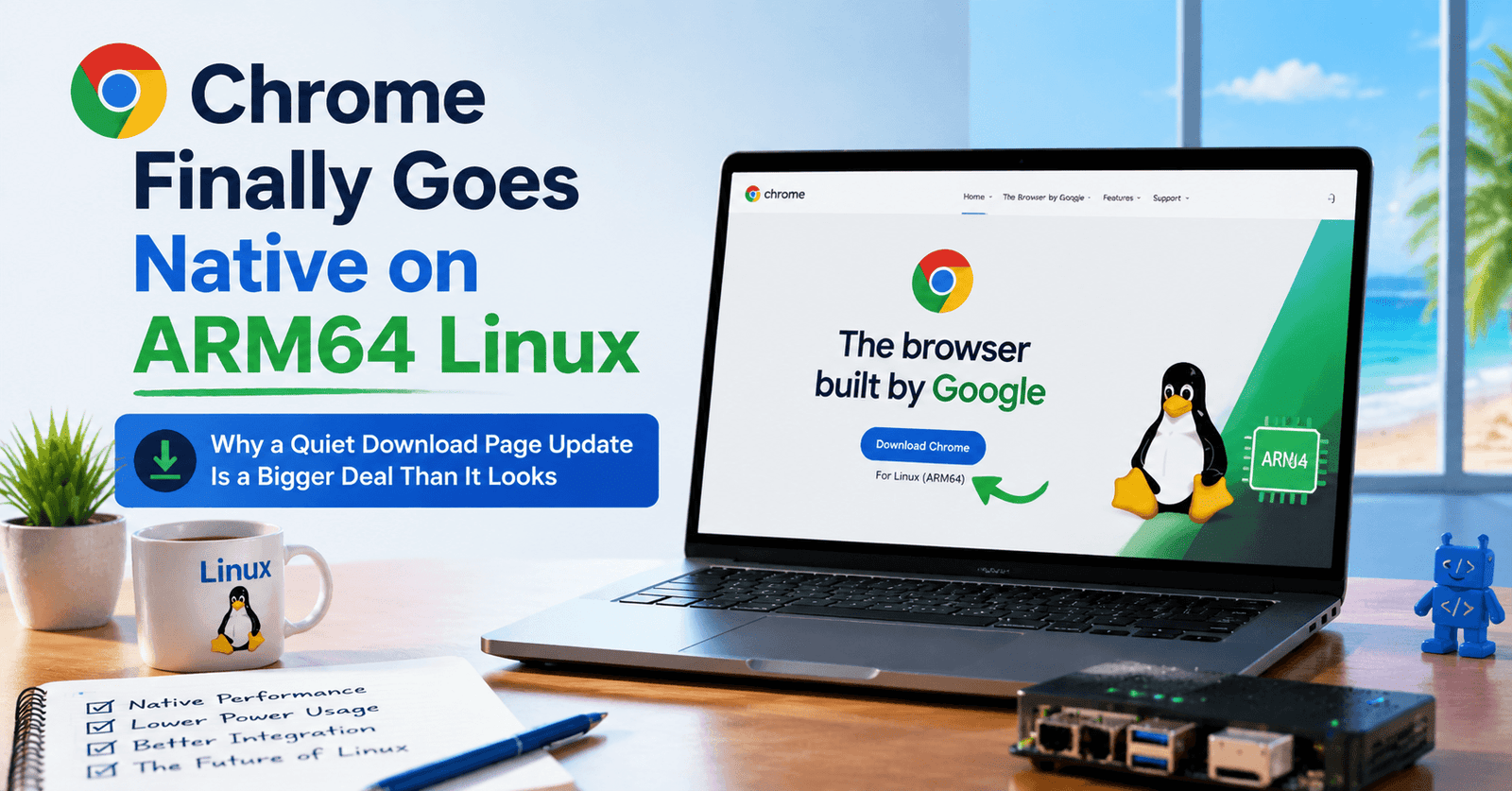
On August 3, 2026, Google made a change to its Chrome download page that most users will never consciously notice, and that a smaller but very vocal community of Linux users has been waiting years for: native ARM64 builds of Chrome, available directly for Debian, Ubuntu, Fedora, and openSUSE. No beta flag, no separate experimental channel, no third-party repackaging required. Just a build, compiled for the architecture, sitting on the official download page next to the familiar x86-64 packages.
It is easy to undersell how unglamorous this sounds. A browser getting a native build for a chip architecture is not the kind of announcement that trends on social media. But for the ARM Linux ecosystem specifically, it closes one of the last conspicuous gaps between “Linux on ARM is technically possible” and “Linux on ARM is something an ordinary person could use as a daily driver without compromise.”
Why This Was a Gap in the First Place
For years, running Linux on ARM64 hardware — increasingly common thanks to the proliferation of efficient ARM-based laptops, single-board computers, and cloud instances — meant either compiling Chrome from source, relying on community-maintained unofficial builds of debatable long-term reliability, or falling back to Chromium, the open-source project Chrome is built on, which has had reasonably solid ARM64 support for a while but lacks some of Chrome’s proprietary conveniences: built-in Widevine DRM for streaming services, Google’s sync infrastructure, certain codec licensing, and the polish of an officially supported release.
None of those workarounds were catastrophic, but all of them added friction, and friction is exactly the kind of thing that quietly pushes people back toward architectures and operating systems that “just work.” Every unofficial build a user has to trust, every DRM-locked streaming service that refuses to play nicely, is a small tax on choosing ARM Linux over the well-trodden x86-64 path.
The Timing Is Not a Coincidence
This update lands at a moment when ARM-based computing is having a genuinely strong run on the desktop and laptop side of the market, not just in mobile and embedded devices where it has long dominated. Efficient, fanless ARM laptops running Linux have become a legitimate category rather than a hobbyist curiosity, and several major distributions have invested heavily in improving their ARM64 installation experience over the past two years.
It is also worth noting that this Chrome update arrives during a broader stretch of momentum for desktop Linux generally. Recent tracking data suggests the Linux desktop’s market share in North America has crossed the 10 percent threshold for the first time — a milestone that would have seemed almost fanciful a decade ago, when Linux desktop share hovered in the low single digits for years without meaningfully budging. Whether that number holds, dips, or keeps climbing, it reflects a real shift in who is choosing Linux and why: not just developers and enthusiasts, but a growing slice of everyday users drawn by improved hardware support, better out-of-box experiences, and, increasingly, genuine architecture diversity.
What Changes for Users, Practically Speaking
For someone running Debian, Ubuntu, Fedora, or openSUSE on ARM64 hardware today, the practical upgrade path is refreshingly boring, which is exactly the point: download the appropriate package from Chrome’s official site the same way an x86-64 user always has, install it through the standard package manager, and get an experience that should be functionally identical — same sync, same extensions ecosystem, same DRM support for streaming — to what x86-64 users have had for years.
That parity matters more than a simple feature checklist suggests. A huge amount of the friction in switching operating systems or architectures comes not from any single dramatic incompatibility, but from a long tail of small annoyances: a streaming service that stutters, an extension that doesn’t quite work, a sync feature that silently fails. Native, officially supported builds eliminate an entire category of those annoyances at once, because Google is now testing and maintaining the ARM64 build with the same seriousness it applies to x86-64.
The Ripple Effect on the Broader Software Ecosystem
Google shipping an official ARM64 Chrome build also functions as a quiet signal to the rest of the software industry. Chrome is, by a wide margin, the most-used browser on the planet, and it is also the rendering engine underneath a long list of other applications built on Chromium or Electron. When the browser that anchors that entire ecosystem gets serious, first-party ARM64 support, it lowers the bar for every downstream project that has been hesitant to prioritize ARM64 builds of its own.
Electron-based desktop applications — a category that includes a huge swath of modern productivity, communication, and developer tools — have historically lagged on ARM64 Linux support specifically, even when they had reasonably solid support for ARM64 on macOS. Chrome’s move does not automatically fix that lag, but it removes one of the most common excuses: “our core dependency doesn’t have solid ARM64 Linux support” is a much weaker argument once the world’s most popular browser engine does.
Part of a Bigger Week for Linux ARM64 Momentum
This Chrome update did not land in isolation. The same general window saw an experimental effort to bring an open-source Vulkan graphics driver to Windows via a compatibility layer, continued progress toward beta status for a next-generation Linux desktop environment built around modern packaging principles, and a fresh round of distribution releases across the ecosystem. None of these individually is headline-grabbing, but stacked together, they paint a picture of a Linux ecosystem investing seriously in polish and parity rather than simply chasing raw capability.
What to Watch Next
The obvious next question is which other major, previously x86-64-centric applications follow Chrome’s lead. Browsers tend to set the tone for the rest of the desktop software market because they are the single application almost every user, on any platform, considers non-negotiable. If Chrome’s ARM64 build proves stable and well-maintained over the coming release cycles — and there is no particular reason to expect otherwise, given Google’s existing ARM64 investment on Android and ChromeOS — it becomes considerably harder for other major cross-platform software vendors to justify treating ARM64 Linux as a second-class target.
For the average reader who does not personally run Linux on an ARM chip, this news might reasonably seem like a rounding error in a very large industry. But architecture diversity on the desktop has been one of the more stubbornly slow-moving fronts in software for the better part of two decades, largely because it requires the entire stack — operating system, browser, applications, drivers — to move roughly together. A native Chrome build on ARM64 Linux is one more piece of that stack quietly falling into place.
The Bottom Line
Google’s decision to ship official ARM64 Chrome builds for four major Linux distributions will not make headlines outside of a relatively narrow slice of the tech press, and that is precisely why it is worth paying attention to. The most consequential shifts in software infrastructure rarely look dramatic in the moment. They look like a download page quietly growing a new set of package links, closing a gap that a smaller, patient community had been asking about for years.
A Brief History of Chrome and ARM, and Why It Took This Long
It is worth remembering that this is not Google’s first ARM64 rodeo. Chrome has shipped on ARM64 for Android since the architecture became standard on mobile, and ChromeOS has run on ARM-based Chromebooks for the better part of a decade. What made desktop Linux different, and slower to reach parity, was largely a matter of priorities and packaging complexity rather than any fundamental technical obstacle. ARM64 Linux desktop and laptop hardware was, until fairly recently, a genuinely small slice of Chrome’s overall user base, which made it a reasonable candidate for deprioritization whenever engineering resources were tight. Officially supporting a new architecture across four separate distribution families also means committing to ongoing testing, packaging, and support infrastructure, not just a one-time compile — a commitment companies are naturally cautious about making until the user base justifies the maintenance burden.
What likely tipped the calculation is the compounding effect of several trends arriving together: cheaper and more capable ARM64 silicon reaching consumer laptops, cloud providers increasingly offering ARM64 instances at a meaningful cost advantage over x86-64 equivalents, and the steady, if slow, growth of desktop Linux market share overall. Individually, none of those trends would have been decisive. Together, they crossed whatever internal threshold makes an official, fully supported ARM64 Chrome build worth the ongoing investment.
What This Means If You Are Choosing Hardware Right Now
For anyone currently shopping for a new laptop or evaluating a cloud development environment and weighing ARM64 against the traditional x86-64 path, this update removes one of the more legitimate hesitations from the decision. A browser is not a peripheral concern in that calculation — it is arguably the single most-used application on most people’s machines, and knowing that it is now a first-party, fully maintained citizen on ARM64 Linux, rather than a workaround, is the kind of unglamorous reassurance that actually moves purchasing decisions in practice, even if it never shows up in a spec sheet comparison.

Leave a Reply