

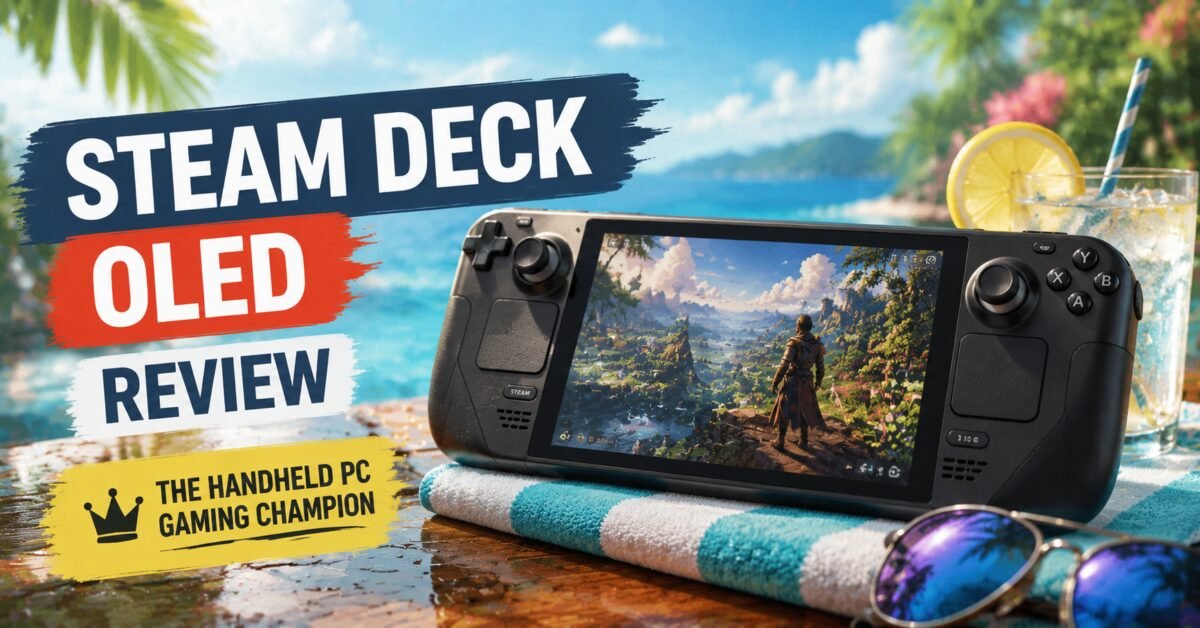
Rating: 8.9 / 10 — Best Handheld for PC Gaming Purists
Introduction: Valve’s Quiet Handheld Revolution
The original Steam Deck proved that a legitimate PC gaming handheld could exist without compromising your existing library or forcing you into a walled garden. The OLED revision doesn’t reinvent that formula — instead, it polishes nearly every rough edge of the original into something that feels genuinely premium. Having used it as our primary travel gaming device for an extended stretch, alongside the growing wave of competing handhelds now on the market, we wanted to see whether Valve’s refinement is enough to keep the Deck at the top of the handheld PC category in 2026.
Design and Build Quality
The most immediately noticeable change is the display: a vibrant OLED panel with genuinely inky blacks, wider viewing angles, and a higher refresh rate ceiling than the original LCD model. It transforms the experience of playing in dim lighting, with HDR-capable content looking dramatically better than before. Beyond the screen, Valve trimmed the weight slightly and improved the ergonomic grip contours, making longer sessions noticeably more comfortable on the hands and wrists.
The trackpads and thumbsticks retain their excellent original feel — a big part of what made the Deck usable for genres traditionally considered mouse-and-keyboard territory, like real-time strategy and point-and-click adventures. Build quality throughout feels tighter, with reduced button rattle and a sturdier hinge on the case compared to early production units of the original model.
Performance: Efficient Rather Than Explosive
The Deck OLED doesn’t chase raw horsepower the way dedicated consoles do. Instead, Valve focused on efficiency, and the results show in battery life and thermal management rather than benchmark charts. The custom APU handles the vast majority of the Steam library at playable frame rates when settings are tuned appropriately, though demanding, cutting-edge titles at native resolution remain outside its comfort zone.
| Component | Steam Deck OLED | Original LCD Model |
|---|---|---|
| Display | 7.4″ HDR OLED, 90Hz | 7″ LCD, 60Hz |
| Battery Life | 3–12 hours (usage dependent) | 2–8 hours |
| Weight | ~640g | ~669g |
| Storage Options | 512GB / 1TB NVMe | 64GB–512GB |
| Cooling | Redesigned fan, quieter operation | Louder under load |
What genuinely impresses is battery efficiency — the new 6nm chip fabrication process delivers noticeably longer sessions per charge compared to the original, without sacrificing performance. Combined with faster Wi-Fi 6E connectivity for smoother cloud saves and downloads, the day-to-day experience feels meaningfully more polished than the number-on-paper improvements might suggest.
User Interface and Software Experience
SteamOS continues to be the Deck’s secret weapon. The console-style interface hides the complexity of a full Linux desktop underneath, but that desktop mode remains accessible for anyone who wants to install alternative launchers, emulators, or productivity software. Valve’s Proton compatibility layer has matured significantly since launch, and the vast majority of the Steam catalog — even titles never officially designed with a handheld in mind — now runs with minimal fuss.
The Deck’s verified/playable compatibility rating system continues to be one of the most transparent tools in the industry, letting you check before purchase whether a game will run well on the hardware, and it has become noticeably more accurate and comprehensive over time.
Game Library and Ecosystem
This is the Deck’s single greatest advantage over every competitor: it’s not locked to a proprietary storefront. Your existing Steam library works immediately, and increasingly, other PC storefronts can be installed via desktop mode with a bit of manual setup. For anyone with years of accumulated PC purchases, this makes the Deck feel less like a new platform to buy into and more like a new way to access a library you already own.
Community-driven tools and custom configurations continue to expand what’s possible on the hardware, from performance overlays to per-game control profile sharing, giving the Deck an almost bottomless well of user-generated refinement that closed platforms simply can’t match.
Value and Pricing Considerations
Compared to building a similarly portable gaming PC from scratch, the Deck OLED remains an excellent value, especially once you factor in the free access to your existing Steam library. Storage tier selection matters here — we’d recommend skipping the base configuration if you plan to install more than a handful of modern titles, since download sizes for AAA games continue to climb.
Audio and Haptics
The upgraded speakers deliver noticeably richer sound than the original model, with better stereo separation that makes a real difference in games without headphones handy. HD haptics in the trackpads continue to be an underrated feature, adding a genuine sense of tactile feedback to mouse-driven genres and even simulating physical button clicks convincingly enough that many players forget they’re touching a flat glass surface rather than real buttons.
Multiplayer and Online Experience
As a Steam-native device, the Deck OLED inherits all of Steam’s existing social and multiplayer infrastructure — friend invites, Remote Play Together, and voice chat all work exactly as they do on desktop, with no platform-specific compromises. This is a quiet but significant advantage over closed console ecosystems: your entire Steam friends list and multiplayer history come with you, rather than existing in a separate, disconnected silo.
Accessories and Compatibility
Dock options have expanded significantly since launch, with both Valve’s official dock and a healthy third-party market offering various combinations of USB-C, HDMI, and Ethernet passthrough for turning the Deck into a makeshift home console when connected to a TV. Original Steam Deck cases and most third-party accessories remain compatible with the OLED model thanks to largely unchanged external dimensions, a small but appreciated consideration for upgraders.
Who Should Actually Buy This
The Deck OLED is the clear choice for PC gamers who want portability without abandoning their existing library, tinkerers who enjoy the flexibility of a genuinely open operating system, and anyone frustrated by how heavy modern gaming laptops have become for travel. Players chasing maximum raw performance for the newest, most demanding AAA titles at high settings may be better served by pricier competing handhelds with more powerful internals, but for the majority of the Steam catalog, the Deck OLED remains comfortably capable.
Long-Term Outlook
Valve’s continued software investment in SteamOS and Proton compatibility means the Deck’s real-world capability has actually improved over time through updates alone, independent of any hardware changes. That trajectory gives us confidence the OLED model will continue to age well, with software optimizations likely to expand its practical game compatibility even further in the years ahead.
Comparing Against the Competition
A growing field of Windows-based handhelds now offers stronger raw performance than the Deck, often at a noticeably higher price and with the added complexity of a full desktop operating system not originally designed for a small touchscreen. The Deck’s advantage has never really been about winning benchmark charts — it’s about the elegance of SteamOS’s console-like layer sitting on top of genuine PC flexibility underneath. For players who want that specific balance, competing hardware still hasn’t quite matched Valve’s execution, even years after the original model’s debut.
Travel and Everyday Use
The improved weight distribution and grip contours make a noticeable difference on longer commutes and flights, and the higher-capacity storage options mean fewer painful decisions about which games to keep installed before a trip. Sleep mode remains near-instant, letting you pick up mid-game after being interrupted, a small convenience that matters enormously for anyone gaming in short, unpredictable bursts throughout a busy day.
Pros and Cons
- Pros: Gorgeous OLED display, meaningfully improved battery life, full access to existing Steam library, open software ecosystem, excellent build refinements, strong haptics and audio.
- Cons: Not powerful enough for the most demanding titles at high settings, learning curve for desktop mode tinkering, competing handhelds now offer more raw performance at a premium.
Final Verdict
The Steam Deck OLED is proof that refinement matters just as much as raw specs. Valve didn’t chase a bigger number on a spec sheet — it fixed the display, battery life, and comfort issues that mattered most to real-world use, while preserving the open, library-agnostic philosophy that made the original such a breath of fresh air. For PC gamers who want their existing library in their pocket, this remains the handheld to beat, and it continues to be the device we reach for most often when heading out the door.
Frequently Asked Questions
Can the Steam Deck OLED run every Steam game? Most, though performance varies significantly by title; Valve’s compatibility ratings are a reliable guide before purchase.
Is the OLED model a big upgrade over the original? The display and battery life improvements alone make it a meaningful upgrade for anyone considering a first purchase.
Can I install other game launchers? Yes, via desktop mode, though setup requires more manual effort than the native Steam experience.
Is the OLED model heavier or lighter than the original? It’s slightly lighter and better balanced, thanks to internal component redesigns and a revised cooling system layout.
Does the OLED model support external GPU docks? Yes, USB4 connectivity allows compatible external graphics enclosures to be used for a substantial performance boost when docked at a desk.

Leave a Reply