

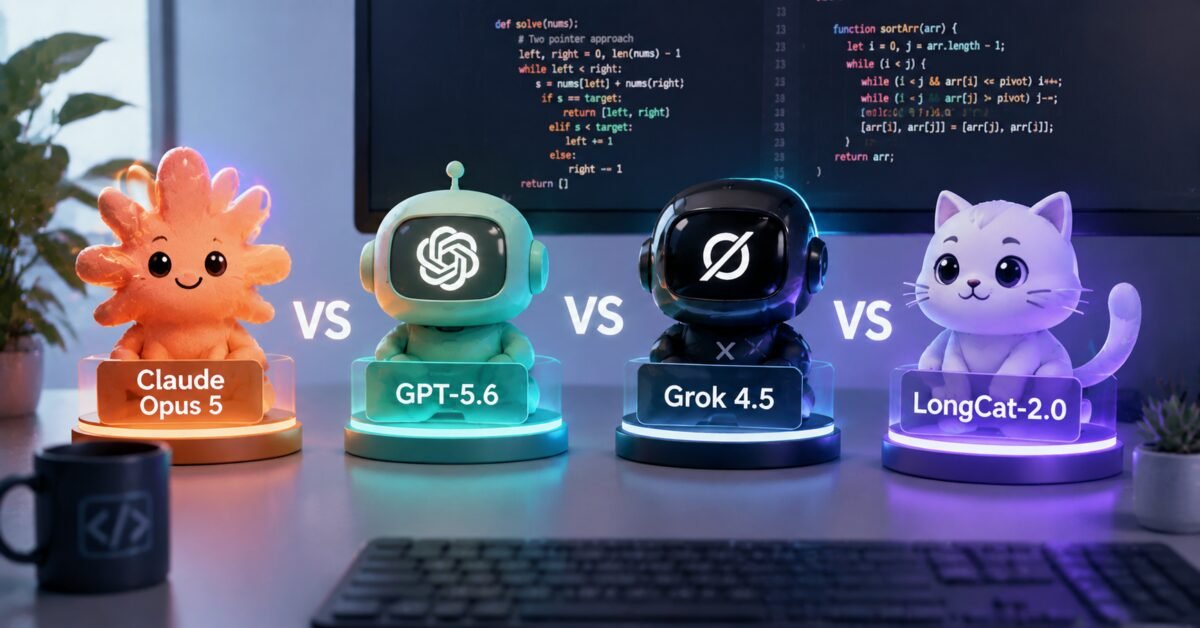
Coding is the single most competitive battleground in AI right now, and the leaderboard has genuinely changed hands multiple times this year. An open-weight challenger briefly took the top spot on the toughest software-engineering benchmark before a closed frontier model reclaimed it just over a week later. If you write code for a living — or you’re building autonomous coding agents — here’s how the real contenders stack up in mid-2026.
🏆 Quick Ranking
| Rank | Model | Best For |
|---|---|---|
| 1 | Claude Opus 5 | Complex, real-world software engineering |
| 2 | GPT-5.6 (Sol tier) | Long-horizon autonomous coding agents |
| 3 | Grok 4.5 | Fast iteration and competitive coding speed |
| 4 | LongCat-2.0 (open-weight) | Self-hosting and full control |
Why Coding Benchmarks Got So Interesting This Year
For most of AI’s history, closed frontier labs dominated coding benchmarks by a wide margin. That changed this year when an open-weight, MIT-licensed model briefly climbed to the very top of one of the field’s toughest software-engineering tests — a genuine first for an openly available model. The lead didn’t last; a refreshed Claude model reclaimed the top spot roughly a week and a half later. But the episode mattered: it proved open-weight coding models are now close enough to the frontier that the gap is measured in days, not years.
Claude Opus 5: The Benchmark Leader
Claude Opus 5 currently sits at the top of the field’s hardest real-world coding benchmark, the kind that simulates actual pull requests, bug fixes, and multi-file refactors rather than isolated algorithm puzzles. What sets it apart isn’t just raw problem-solving — it’s reliability. Developers consistently report that Claude’s code compiles cleanly, respects existing code style, and rarely introduces the kind of subtle logic errors that are painful to track down in review.
Claude also handles large, pre-existing codebases unusually well. It can hold a huge amount of project context in mind at once, which means it’s less likely to “forget” a convention you established fifty files ago. For teams doing serious refactors or working inside legacy systems, this consistency is worth more than a few extra benchmark points.
GPT-5.6: Built for Autonomous Agents
GPT-5.6’s top reasoning tier, internally called Sol, was built with agentic coding in mind from day one. It currently leads the field on agentic CLI benchmarks — tests that measure how well a model can operate a terminal, chain together dozens of tool calls, and recover from its own mistakes without a human stepping in. If you’re building a coding agent that needs to run unsupervised for an extended stretch — cloning a repo, running tests, fixing failures, opening a pull request — GPT-5.6 currently has the edge in that specific discipline.
It’s paired with Codex, OpenAI’s dedicated coding agent product, which wraps the model in an interface built specifically for repository-scale work rather than single-file chat. For teams already standardized on the OpenAI ecosystem, this integration removes a lot of the glue code you’d otherwise have to write yourself.
Grok 4.5: The Speed Play
xAI’s Grok 4.5 launched as a coding-focused release, and its main selling point is iteration speed. In practice, that means faster turnaround on the tight “write code, run it, see the error, fix it” loop that dominates real development work. It isn’t the benchmark leader in raw accuracy, but for teams that value quick iteration over squeezing out the last percentage point of correctness, it’s a genuinely competitive option, especially at its price point.
LongCat-2.0: The Open-Weight Wildcard
LongCat-2.0 is a massive, 1.6-trillion-parameter open-weight coding model released under the MIT license, notable for being trained entirely on domestic chips rather than the usual supply chain. Its brief run at the top of a major coding leaderboard proved open models can compete with closed frontier labs on pure capability. The tradeoff is operational: running a model this size yourself requires serious infrastructure, and you lose the polish, safety tooling, and support that come bundled with a hosted product. For organizations with strict data-residency requirements or a genuine need to self-host, though, it’s now a credible option rather than a compromise.
Head-to-Head: What the Benchmarks Actually Measure
It’s worth being skeptical of any single number. The benchmarks that get quoted most — hard software-engineering suites, agentic terminal tests, competitive-programming problem sets — each measure a different skill, and a model can lead on one while trailing on another. A model that’s brilliant at solving an isolated algorithmic puzzle isn’t automatically the best choice for untangling a decade-old codebase, and vice versa. Treat leaderboard rank as a hint, not a verdict, and weight it against the kind of coding work you actually do day to day.
Practical Recommendations by Use Case
- Enterprise codebases, refactors, and code review: Claude Opus 5.
- Autonomous agents running for hours without supervision: GPT-5.6 (Sol tier) with Codex.
- Rapid prototyping and quick iteration loops: Grok 4.5.
- Self-hosted, data-sovereign, or budget-constrained infrastructure: LongCat-2.0.
- Small teams wanting the best free or cheap option: Check current API pricing — the gap between open and closed models has narrowed enough that self-hosting is now cost-competitive at scale.
Pricing Snapshot
| Model | Access Model | Notes |
|---|---|---|
| Claude Opus 5 | API + subscription | Premium pricing, premium reliability |
| GPT-5.6 Sol | API + subscription tiers | Higher cost for the top reasoning tier |
| Grok 4.5 | API + subscription | Competitive mid-tier pricing |
| LongCat-2.0 | Self-hosted, MIT license | Free to run; infrastructure cost only |
Real-World Test: Fixing a Bug in an Unfamiliar Codebase
Benchmark scores are useful, but they don’t always predict how a model behaves on the messy, ambiguous work developers deal with daily. A common informal test is dropping a model into an unfamiliar, moderately large codebase and asking it to fix a bug without any other context. Claude Opus 5 consistently spends more of its initial response exploring the codebase — reading related files, checking for existing patterns — before proposing a fix, which tends to produce changes that fit naturally with the surrounding code. GPT-5.6 is faster to propose a fix but occasionally needs a second pass once it discovers a convention it missed the first time. Grok 4.5 lands somewhere in between, with a bias toward speed that pays off when the bug is straightforward and costs a bit of accuracy when it isn’t. LongCat-2.0 performs impressively for an open-weight model but generally needs clearer, more explicit instructions than the closed frontier models to reach the same quality bar.
Code Review and Refactoring Ability
Writing new code and reviewing existing code draw on different strengths, and it’s worth testing both separately if code quality matters to you. Claude Opus 5 remains the strongest of the group at reviewing pull requests critically — it’s more likely to flag a subtle edge case or a style inconsistency rather than simply confirming the code “looks fine.” GPT-5.6 is thorough but occasionally verbose in its review comments, surfacing more minor nitpicks than some teams want in a first pass. For large-scale refactors spanning many files, Claude’s ability to hold more project context in working memory continues to be its clearest practical advantage over the other three models.
Working With Legacy and Poorly Documented Code
A large share of real-world coding work isn’t greenfield development — it’s maintaining old, sparsely documented systems. This is where model choice matters most, because it’s exactly the scenario where a model’s training and tuning priorities show up most clearly. Claude’s emphasis on careful exploration before acting tends to pay off here: it’s less likely to make a confident but wrong assumption about undocumented behavior. GPT-5.6’s agentic strength becomes valuable here too, particularly when the task involves running the existing test suite repeatedly to verify a fix rather than just reading the code and guessing.
Setting Up an Open-Weight Model: What It Actually Takes
If LongCat-2.0 or a similar open-weight model is on your radar, it’s worth being realistic about the setup cost. Running a trillion-parameter-class model at usable speed requires serious GPU infrastructure, and most teams underestimate the ongoing engineering time needed for monitoring, updates, and the safety tooling that hosted providers handle automatically. For a small team without dedicated infrastructure staff, a hosted API — even a premium one — is often cheaper once you account for engineering hours. Self-hosting tends to make the most sense for larger organizations with existing ML infrastructure, strict data-residency rules, or high enough request volume that the economics clearly favor it.
Frequently Asked Questions
Is an open-weight model actually safe to use for production code?
Increasingly, yes — but you take on responsibility for the surrounding tooling, monitoring, and safety checks that hosted products build in for you.
Which model should a solo developer start with?
Claude Opus 5 for correctness-critical work, or Grok 4.5 if you want faster, cheaper iteration on smaller projects.
Will this ranking hold up?
Probably not for long. Coding leaderboards have changed hands multiple times in 2026 alone — check current benchmarks before making a long-term commitment.
Should I use different models for different parts of my workflow?
Many teams do — for example, a fast, cheap model for routine tickets and a top-tier model reserved for the hardest bugs and largest refactors.
Bottom Line
Coding is no longer a two-horse race between OpenAI and Anthropic. Grok has staked out a real speed niche, and open-weight models have proven — even if briefly — that they can lead the field outright. Pick based on whether you need maximum correctness (Claude), autonomous agent stamina (GPT), fast iteration (Grok), or full infrastructure control (LongCat), and revisit the choice every quarter.


Leave a Reply