

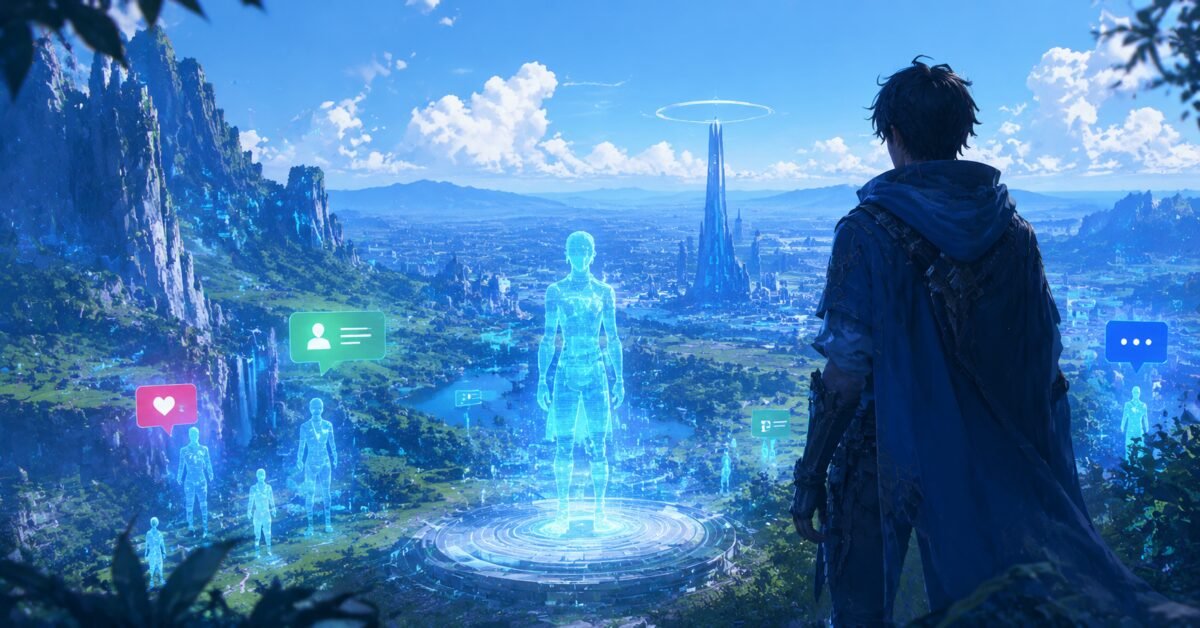
For decades, non-player characters have been the wallpaper of virtual worlds — functional, forgettable, and endlessly recycled. That is changing faster than almost anyone in the industry predicted, and the shift is rewriting what “immersion” even means.
The Problem With the Old NPC
Ask any longtime player to describe a typical NPC and you’ll get the same answer: a merchant who repeats three lines of dialogue on a loop, a guard who says “halt” the same way every single time you walk past, a quest-giver whose emotional range begins and ends with a floating exclamation mark. For nearly forty years, game worlds have been populated by characters that are, in the most literal sense, scripted — bound to branching dialogue trees written months or years before a single player ever meets them.

That model worked because the alternative was prohibitively expensive. Writing, recording, and animating dynamic dialogue for hundreds of characters requires an army of writers, voice actors, and animators, and even then the result is still finite. Players quickly learn the boundaries of a scripted world, and once they do, the illusion collapses.
What’s Actually Changing
The current wave of experimentation centers on pairing large language models with game engines in real time, allowing NPCs to generate contextual dialogue on the fly rather than pulling from a pre-written tree. Instead of a fixed set of responses, a shopkeeper can comment on what the player is currently carrying, remember an earlier conversation, or react differently depending on the state of the surrounding world.
Several studios — spanning both AAA publishers and small independent teams — have begun shipping early implementations of this technology in limited, contained ways: a tavern full of patrons who gossip about recent in-game events, a companion character whose personality subtly shifts based on player choices, or a detective-style NPC who can answer open-ended questions about a case rather than only the three the writers anticipated.
“The goal isn’t to replace writers,” one narrative director at a mid-sized studio explained during a recent industry panel. “It’s to give the world texture between the moments writers have carefully crafted. The big story beats are still authored. The small talk in between is where this technology shines.”
Why Players Are Divided
Reception has been anything but unanimous. Supporters argue that dynamic NPCs finally solve the “theme park” problem — the sense that a game world exists purely to funnel players toward the next scripted event. When an NPC can genuinely respond to an unscripted question, the world feels less like a set of rails and more like a place.
Critics, meanwhile, point to a familiar set of concerns:
- Tonal inconsistency — a generative NPC can produce dialogue that clashes with a game’s carefully established voice and lore.
- The uncanny valley of conversation — text that is grammatically fluent but emotionally flat can feel more unsettling than a simple, honest repeated line.
- Loss of authorial intent — some players feel that hand-written dialogue, however limited, carries a craftsmanship that generated text lacks.
- Technical overhead — running inference locally or via the cloud during gameplay introduces latency and cost concerns that are still being worked out.
There’s also a quieter, more practical worry circulating among narrative designers: if dialogue can be generated on demand, will studios invest less in the writers who currently give game worlds their voice? So far, most teams experimenting with the technology insist the opposite is true — that writers are being repositioned as “world architects” who define the boundaries, personality profiles, and lore constraints the AI must operate within, rather than being replaced outright.
The Technical Reality Behind the Hype
Building a dynamic NPC system involves far more than plugging a chatbot into a game engine. Studios working on these systems describe a layered approach: a lightweight local model handles low-stakes ambient chatter, while more complex conversations route through more capable systems with tighter guardrails to prevent the NPC from breaking character, leaking spoilers, or generating anything inappropriate.
Memory is another major hurdle. For an NPC to feel truly reactive, it needs to remember relevant details across potentially dozens of hours of gameplay without needing to reprocess the entire history every time — a problem that has pushed several teams to build custom “memory summarization” layers that compress important moments into compact profiles the AI can reference instantly.
Latency remains the single biggest technical obstacle. A generated response that takes several seconds to appear can shatter immersion just as effectively as a bad line of scripted dialogue. Teams are experimenting with techniques like pre-generating likely responses during loading screens, streaming text token by token so players see a reply forming immediately, and caching common conversational patterns to reduce the load on live inference.
Where This Is Headed
Industry observers expect the next eighteen months to bring a wave of “hybrid” narrative design — games that use hand-authored dialogue for critical story beats and dynamic generation for ambient, exploratory, or optional interactions. This middle path sidesteps many of the current criticisms while still delivering the sense of a living world that fully scripted games struggle to achieve.
There’s also growing interest in using this technology for accessibility purposes — allowing players to type or speak questions naturally to an NPC rather than navigating a menu of pre-set options, which could meaningfully change how games are played by people with different physical or cognitive needs.
Longer term, some developers are exploring persistent NPCs that carry memories and relationships across an entire playthrough, or even across a save file that a player returns to months later. The idea of a game world that genuinely remembers you — not through a save file flag, but through characters who reference specific things you did — remains one of the most ambitious goals in this space, and one that’s still years away from mainstream execution at scale.
The Cost Equation Studios Are Still Working Out
Running inference for hundreds or thousands of concurrent players introduces a cost structure that traditional game development simply never had to account for. A scripted line of dialogue, once written and recorded, costs nothing additional no matter how many players hear it. A generated line, by contrast, consumes compute resources every single time it’s produced, and that cost scales directly with a game’s player count rather than shrinking over time the way most development costs do.
This has pushed studios toward a variety of cost-management strategies. Some cap the number of dynamic interactions available per session, reserving generative dialogue for specific “showcase” NPCs rather than the entire cast. Others rely on smaller, more efficient models that sacrifice some conversational nuance in exchange for dramatically lower running costs. A few have begun exploring hybrid pricing models where publishers pass a portion of the ongoing inference cost on to players through premium editions or subscription tiers — an approach that has, predictably, generated its own share of controversy among players who feel core gameplay features shouldn’t come with a recurring cost attached.
Voice Acting in an AI-Generated World
Text generation is only half of the puzzle. For an NPC’s dialogue to feel complete, it typically needs a voice, and the question of how to pair dynamically generated text with performed audio has become one of the thornier problems in this space. A handful of studios have experimented with AI-generated voice synthesis trained on a voice actor’s original performance, allowing a character to “speak” lines that were never actually recorded — a practice that has triggered significant pushback from voice actor unions and performers concerned about consent, compensation, and the long-term devaluation of vocal performance as a craft.
Other studios have taken a more conservative approach, limiting dynamic dialogue to on-screen text only, or restricting AI-generated voice work to minor, clearly disclosed background characters while keeping all major roles fully human-performed. Expect this particular debate — over compensation, consent, and creative credit — to remain unresolved and contentious for years, regardless of how quickly the underlying technology continues to improve.
Lessons From Early Failures
Not every experiment with dynamic NPCs has gone smoothly, and the industry’s early missteps have been instructive. A handful of high-profile demos have gone viral for exactly the wrong reasons — NPCs producing bizarre, tonally inappropriate, or outright nonsensical responses when players deliberately tried to break the system, undermining confidence in the technology just as it was gaining momentum. These incidents have pushed developers toward far more conservative guardrails than early demonstrations suggested would be necessary, with heavy filtering layers now standard practice for any studio shipping the technology in a finished product rather than a tech demo.
The lesson many studios have taken from these stumbles is one of restraint: it’s far better to ship a smaller, more tightly bounded dynamic system that reliably works than an ambitious one that occasionally embarrasses the game in front of a skeptical audience already primed to distrust the technology.
The Bottom Line
Dynamic, AI-driven NPCs are not going to replace traditional game writing anytime soon, nor should they. What they represent is a new tool in an old craft — one capable of filling the countless small, unscripted moments that make a world feel inhabited rather than staged. Whether players ultimately embrace this shift will depend less on the underlying technology and more on how thoughtfully studios integrate it into the worlds they’re already known for building.
For now, the tavern keeper who remembers your name is still the exception rather than the rule. But that exception is becoming more common every month — and it’s worth watching closely.





Leave a Reply