

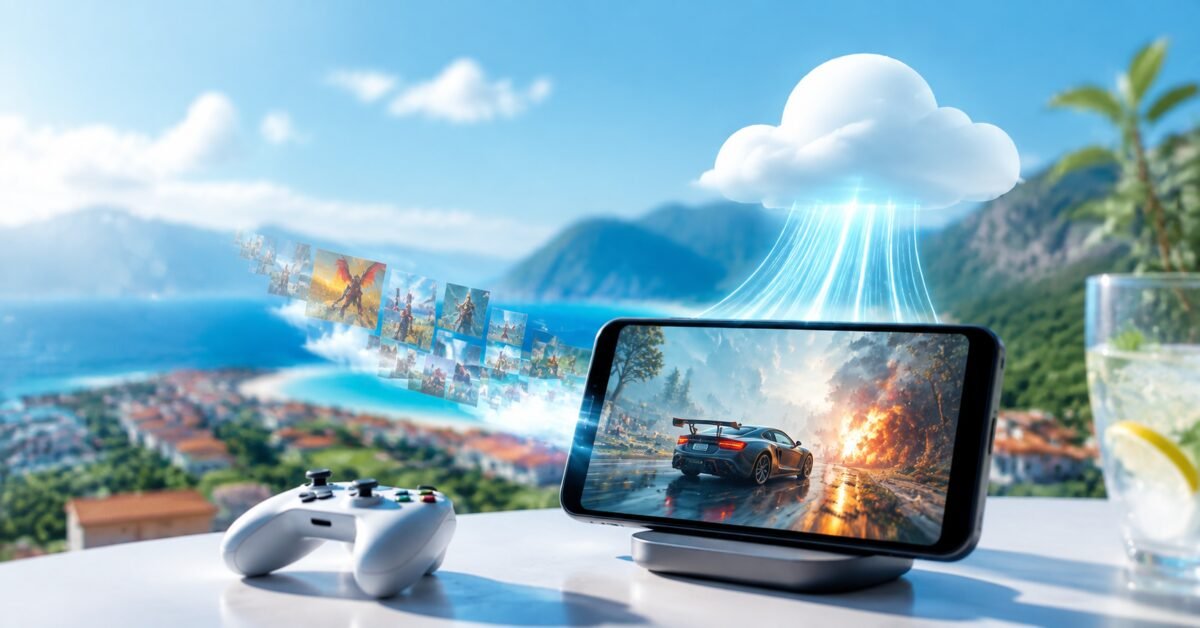
Cloud gaming has spent nearly a decade promising to make hardware irrelevant. In 2026, that promise finally looks closer to reality — but the path here was messier, and the outcome stranger, than anyone predicted.
A Decade of False Starts
It’s easy to forget how many cloud gaming services have already come and gone. The category has been littered with ambitious launches, quiet shutdowns, and a general sense that streaming a demanding video game over the internet was a solution in search of a problem most players didn’t actually have. Early services struggled with the same trio of issues: latency that made fast-paced games feel sluggish, compression artifacts that turned crisp visuals into a blurry mess during action-heavy scenes, and a business model that never quite justified the enormous server costs required to run thousands of simultaneous gaming sessions.
What’s different now isn’t a single breakthrough — it’s the quiet accumulation of several smaller ones arriving at once.
The Infrastructure Finally Caught Up
Fiber and 5G rollouts that were promised for years have, in many major markets, actually arrived. Round-trip latency in dense urban areas has dropped meaningfully compared to five years ago, and edge-computing data centers — smaller server clusters placed physically closer to population centers — have cut the distance data needs to travel before reaching a player’s screen.
Codec improvements have played an equally important role. Newer video compression standards can preserve far more detail at a fraction of the bitrate older systems required, which matters enormously for cloud gaming specifically because every frame the player sees has already been compressed, transmitted, and decompressed in the time it takes to blink.
Game engines themselves have also adapted. Rather than simply streaming a game built for local hardware, several major titles now ship with rendering profiles specifically tuned for cloud delivery — dynamically adjusting resolution and effects based on network conditions in ways that would be unnecessary for a locally installed game.
Who’s Actually Using It
The interesting story in 2026 isn’t really about hardcore competitive players — that audience remains, correctly, skeptical of any added latency in genres where milliseconds matter. The real growth has come from a different group entirely: players who want access to demanding games without buying demanding hardware.
- Casual and returning players who left gaming for years and don’t want to invest in a new console or gaming PC just to try something out.
- Households with shared devices — a tablet, a smart TV, a laptop — where cloud streaming turns any screen into a potential gaming device.
- Players in regions where high-end gaming hardware remains expensive or difficult to import, for whom a subscription is dramatically more accessible than a $500+ console.
- “Try before you buy” browsers who use free trial hours to sample a game before committing to a full purchase.
This shift in audience has quietly changed how publishers think about cloud platforms — less as a replacement for traditional hardware, and more as an additional storefront and demo tool that happens to also be a full gaming platform.
The Business Model Question Isn’t Fully Solved
Server costs remain the industry’s least-discussed problem. Running a AAA game at high settings for a single player requires dedicated GPU time, and unlike a locally installed game — where the hardware cost is paid once by the player — cloud gaming pushes that cost onto the platform for every single session, indefinitely. Several services have quietly adjusted their pricing models over the past two years, introducing tiered subscriptions that limit high-resolution streaming to premium plans, or capping monthly hours for base-tier subscribers.
There’s a real tension here between what players want — unlimited, high-fidelity access for a flat monthly fee — and what’s economically sustainable for the companies providing it. Industry analysts remain split on whether current pricing structures can support the infrastructure costs long-term without further price increases or advertising integration.
“We’re past the point of proving the technology works,” one platform executive said at a recent conference. “The remaining question is entirely about economics, not engineering.”
Latency: Better, Not Solved
It would be inaccurate to say latency is a solved problem. Fighting games, competitive shooters, and rhythm games remain genres where even small delays are immediately noticeable to experienced players, and cloud platforms generally still recommend a wired connection and a router positioned close to the playing device for anything competitive. What has changed is the baseline experience for everything else — narrative-driven games, strategy titles, most single-player experiences — where the input delay introduced by streaming has dropped below the threshold most players consciously notice.
Independent testing across major services in the past year has shown meaningful, measurable improvement in both average latency and — perhaps more importantly — consistency. Early cloud gaming was plagued by unpredictable spikes; a session might feel smooth for twenty minutes and then stutter badly for no obvious reason. That inconsistency has been substantially reduced, even if it hasn’t disappeared entirely.
What This Means for Traditional Hardware
Console and PC hardware manufacturers haven’t been sitting still. Rather than treating cloud gaming purely as a threat, several have integrated streaming directly into their existing ecosystems, allowing a purchased game library to be accessed both locally and remotely depending on the device at hand. This hybrid approach — own the hardware when you want peak performance, stream when convenience matters more — appears to be where the broader market is settling, rather than a full replacement of one model by the other.
Handheld gaming devices have benefited especially well from this shift, since a lightweight, battery-efficient handheld can now offload the demanding computation to a remote server while presenting the video output locally, extending both the practical library and the battery life of devices that would otherwise struggle to run modern titles natively.
Regional Disparities Nobody Talks About Enough
Coverage of cloud gaming’s improvement tends to focus disproportionately on dense urban markets in wealthy countries, where fiber infrastructure and 5G coverage have advanced the fastest. That framing obscures a much bumpier reality elsewhere. In rural areas, even within countries with generally strong infrastructure, latency and bandwidth limitations remain significant enough that cloud gaming is often simply not a viable option, regardless of how much the underlying technology has improved.
This regional unevenness has created an odd dynamic where cloud gaming’s marketing often promises universal accessibility while its actual reliability varies enormously depending on a player’s specific location — sometimes down to which side of a particular street they live on, depending on local infrastructure. Platforms have generally become more transparent about this limitation than they once were, with most now offering connection-speed testing tools before a subscription purchase, but the gap between the marketed experience and the actual experience in underserved areas remains a real and largely unresolved issue.
The Environmental Conversation
Running compute-intensive game rendering in massive data centers rather than on a player’s personal hardware raises legitimate environmental questions that the industry has been slow to address publicly. Data centers consume enormous amounts of electricity and require substantial water resources for cooling, and shifting millions of gaming sessions from local hardware to centralized servers doesn’t eliminate that energy demand — it concentrates and potentially amplifies it.
Some platform operators have pointed to efficiency gains from centralized computing, arguing that a shared server can be utilized far more efficiently across many players than the same GPU sitting idle in an individual home for most of the day. Critics counter that this efficiency argument ignores the added energy cost of constant high-bitrate video streaming, and that the net environmental impact of cloud gaming at scale remains poorly measured and rarely disclosed by the companies operating these services. Expect this to become a more prominent point of scrutiny as cloud gaming’s player base continues to grow.
Ownership and the Subscription Question
Cloud gaming has reignited a long-running debate about game ownership that predates streaming entirely but has taken on new urgency. When a game exists only as a remote stream rather than a local install, questions about what happens if a title is removed from a service, if a subscription lapses, or if the platform itself shuts down become immediate and practical rather than hypothetical.
Several platforms have responded by clarifying their terms more explicitly, distinguishing between games accessed purely through a subscription library — which can disappear from a player’s access at any time — and games purchased individually, which typically retain cloud-streaming access indefinitely even if a broader subscription is cancelled. This distinction matters enormously to players who’ve grown wary of losing access to a purchased library, a concern that has shaped purchasing habits across digital media well beyond gaming specifically.
The Verdict
Cloud gaming in 2026 isn’t the hardware-replacing revolution its earliest proponents promised a decade ago, and it probably never will be for every genre or every player. But dismissing it as a failed experiment, as many did just a few years ago, no longer matches reality. For a large and growing segment of players, it has quietly become simply another way to play — reliable enough, cheap enough, and convenient enough to matter. The technology finally caught up to the promise. What happens next depends almost entirely on whether the business models built around it can survive their own success.

Leave a Reply