

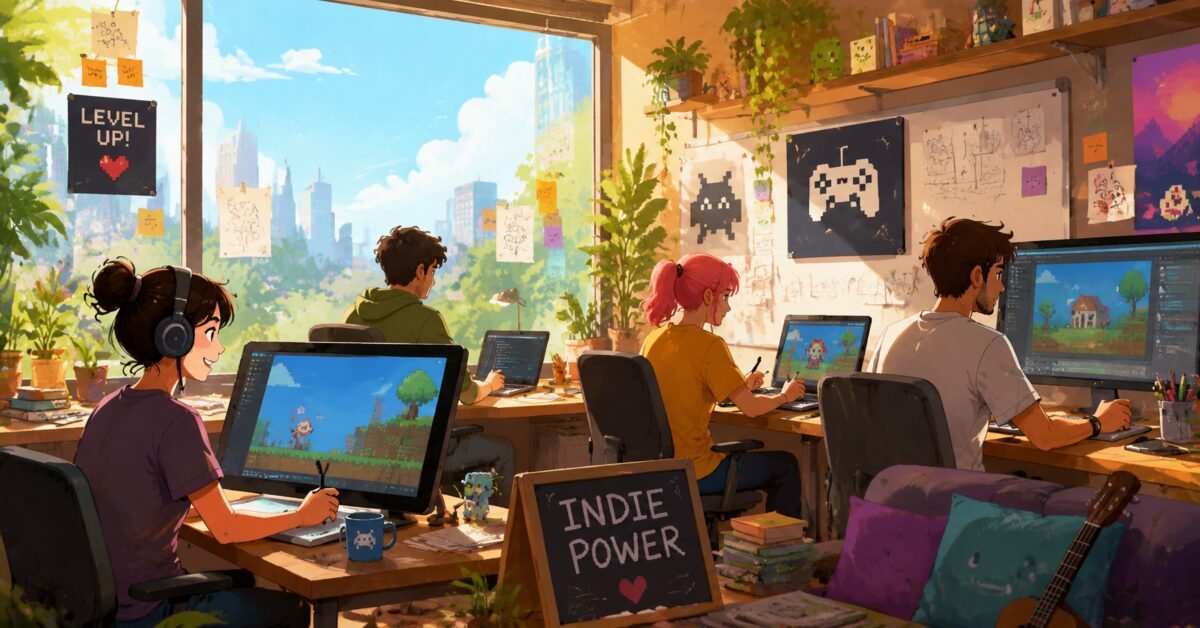
While headlines continue to focus on AAA budgets ballooning past hundreds of millions of dollars, a quieter story has been unfolding at the other end of the industry — and it’s arguably the more interesting one.
A Market Reshaped From the Bottom Up
Independent games have always existed in the shadow of blockbuster releases, but the balance of attention has shifted noticeably over the past few years. Storefronts that once buried indie titles beneath a wall of AAA marketing now regularly feature small-team projects in their top-selling charts, sometimes outperforming games with budgets a hundred times larger. This isn’t a fluke — it reflects real structural changes in how games get made, discovered, and played.
Smaller Teams, Sharper Focus
One of the clearest patterns among recent breakout indie successes is restraint. Rather than trying to compete with AAA studios on scope, the most successful small teams have doubled down on doing one or two things exceptionally well — a tightly designed core mechanic, a distinctive art style, or an unusually well-crafted narrative — instead of spreading thin resources across dozens of systems.
This focus has a practical advantage that’s easy to overlook: a smaller scope means a smaller, more achievable development timeline, which in turn means the game can actually ship before the team runs out of funding. Development horror stories about AAA titles stuck in seven-year production cycles with shifting scopes are almost entirely absent from the indie space, where survival itself often depends on finishing something coherent within a year or two.
The Tools Have Never Been More Accessible
Modern game engines have dramatically lowered the technical barrier to entry. Features that once required dedicated engineering teams — realistic lighting, physics simulation, cross-platform deployment — now come built into widely available, often free, engines. A two-person studio working from a bedroom can produce visuals that would have required a much larger technical team a decade ago.
Asset marketplaces, community tutorials, and AI-assisted development tools have compounded this effect further, allowing small teams to focus their limited time on the parts of a game that actually differentiate it — design, writing, and feel — rather than reinventing foundational systems that dozens of other teams have already solved.
Distribution Without Gatekeepers
Perhaps the biggest shift has happened on the discovery side. Digital storefronts have refined their recommendation systems considerably, and algorithmic discovery combined with active community curation — wishlists, curated indie showcases, and dedicated indie-focused events — has given small games meaningful visibility without requiring the marketing budget of a publisher.
Streaming and content creation have played an outsized role here as well. A distinctive, easily digestible indie game can spread through clips and streams in a way that’s genuinely difficult for larger, more complex titles to replicate — a single compelling ten-second clip can drive more organic interest than a million-dollar trailer campaign, provided the underlying game gives creators something worth sharing.
“We spent our entire marketing budget on nothing, because we didn’t have one,” one two-person studio founder said after their debut title unexpectedly sold hundreds of thousands of copies. “The game found its audience because streamers found something in it worth showing off. That’s not a strategy you can buy — you can only build a game that earns it.”
Publishers Are Adapting Their Approach
Traditional publishers have taken notice of this dynamic, and many have restructured how they work with independent developers as a result. Rather than the older model of acquiring a studio outright or demanding significant creative control in exchange for funding, a growing number of publishing deals now function more like light-touch partnerships — funding, marketing support, and platform relationships in exchange for a share of revenue, while leaving creative decisions largely with the original team.
This shift reflects a hard lesson the industry has learned repeatedly: heavy-handed publisher involvement tends to sand down exactly the distinctive qualities that made a small game stand out in the first place. The games succeeding most in the current market are, almost without exception, the ones where a small team’s specific creative vision was preserved rather than smoothed into something more conventional.
The Financial Reality Is Still Brutal
None of this should suggest that making an indie game has become easy. For every breakout success story, there are hundreds of small teams who pour years of unpaid labor into a project that sells a few hundred copies and effectively ends their studio. The market may be more receptive to indie games than ever, but it’s also more crowded than ever — storefronts now list tens of thousands of new titles annually, and simply making a good game is no longer sufficient to guarantee it gets seen.
Successful indie developers increasingly describe marketing, community-building, and audience development as skills just as essential as design or programming — a shift that has pushed many small teams to bring on a dedicated community manager or marketing-focused member far earlier in development than was common a decade ago.
Genres Thriving in the Indie Space
Certain genres have become particularly fertile ground for independent success:
- Narrative-driven experiences that lean into strong writing and art direction rather than technical spectacle.
- Roguelikes and roguelites, where tightly designed, replayable systems matter more than content volume.
- Cozy and life-simulation games, which have found a large, dedicated audience underserved by most AAA output.
- Retro-inspired titles that intentionally use lower-fidelity visuals both as an aesthetic choice and a practical development shortcut.
- Experimental and genre-blending games that AAA studios, constrained by large budgets and correspondingly large financial risk, are generally unwilling to greenlight.
Funding Models Beyond the Traditional Publisher
Publisher partnerships are far from the only path small studios are taking to fund development. Crowdfunding, while less dominant in the conversation than it was a decade ago when it first exploded onto the scene, remains a viable route for studios with an existing following or a concept distinctive enough to generate organic excitement before a single line of code is written. More recently, revenue-share platforms and specialized indie-focused investment funds have emerged as alternatives, offering upfront capital in exchange for a percentage of future sales rather than equity or full ownership.
Early access has also matured into a genuinely sustainable funding strategy for many small teams, rather than the somewhat controversial stopgap it was often viewed as in earlier years. Releasing a playable, if incomplete, version of a game allows a small studio to generate revenue during development itself, using real player feedback to guide remaining design decisions rather than betting an entire budget on a single, fully-formed launch. The studios that use early access most effectively tend to treat it as an ongoing conversation with their community rather than a simple pre-order mechanism, regularly incorporating feedback in ways that visibly shape the finished product.
The Role of Community in Long-Term Success
Perhaps the most distinctive feature of successful modern indie studios is how directly and continuously they engage with their player communities, often starting years before a game actually releases. Developer blogs, regular social media updates showing work in progress, and direct participation in community discussion have become nearly standard practice, serving simultaneously as marketing, quality assurance, and morale-building for a small team that might otherwise work in relative isolation for years.
This close community relationship carries real risks alongside its benefits. Small teams that build public momentum around a project face outsized pressure if development runs long or a release date slips, in a way that larger studios — with bigger marketing budgets and more diversified public attention — are generally better insulated against. Several notable indie projects have struggled publicly with community backlash after repeated delays, a dynamic that larger, better-resourced studios experience far less acutely even when their own delays are, in absolute terms, considerably longer.
Regional Indie Scenes Worth Watching
While indie success stories often get covered as isolated, individual phenomena, distinct regional scenes have quietly developed their own recognizable characteristics and support infrastructure. Local game development associations, government arts and technology grants in several countries, and regionally focused showcases and festivals have helped cultivate clusters of small studios that both compete and collaborate with one another, sharing knowledge in ways that benefit the broader local scene even as individual studios compete for the same players’ attention.
These regional ecosystems matter because they lower the isolation that has historically made independent development such a precarious career path. A studio embedded in an active local scene has access to peer feedback, shared tooling knowledge, and informal mentorship that a lone developer working in isolation simply doesn’t, and several of the most consistently productive indie regions in recent years owe much of their output to exactly this kind of accumulated community infrastructure rather than any single breakout hit.
Looking Ahead
The current momentum behind indie games doesn’t appear to be a temporary trend so much as a structural rebalancing of the industry. As AAA development costs continue climbing and the financial risk of a single blockbuster failure grows correspondingly larger, publishers have become more conservative with big-budget projects — often relying on established franchises rather than new ideas. That conservatism has left considerable creative space open, and small studios have been the ones stepping into it.
Whether this dynamic holds as more capital flows into the indie space — and with it, the pressures that historically pushed larger studios toward more conservative, market-tested design — remains an open question. For now, though, the smallest teams in the industry are making some of its most memorable, most talked-about games, and that alone marks a genuine shift in how the medium is evolving.



Leave a Reply