

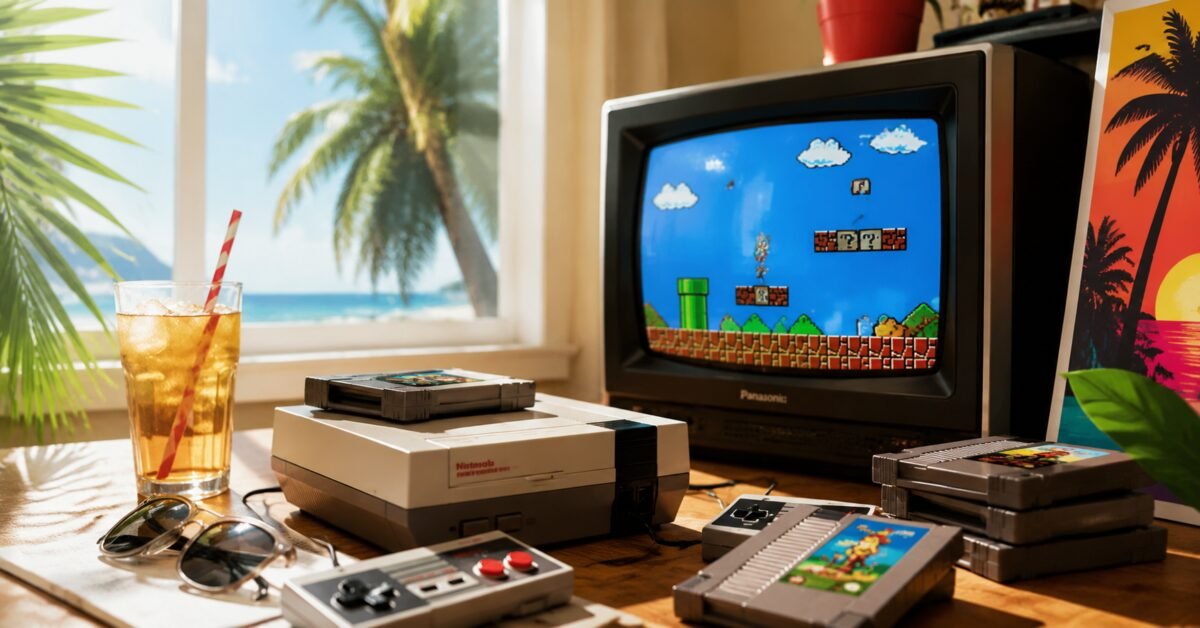
In an industry obsessed with ray tracing, 4K resolutions, and ever-more-demanding hardware, a strangely stubborn counter-trend has been gaining momentum: more players than ever are turning their attention backward.
A Market That Refuses to Shrink
Retro gaming has always had a devoted niche following, but what’s happening now looks less like nostalgia and more like a genuine, sustained market segment with its own economy. Reissued classic consoles, dedicated retro handhelds, and officially licensed remasters of decades-old titles routinely rank among the best-selling gaming products in any given season — often outperforming expectations by a wide margin.
The secondary market tells a similar story. Physical copies of older games, particularly for consoles from the 1990s and 2000s, have seen prices climb steadily, driven by a combination of genuine collector demand and a wave of newer players discovering these libraries for the first time.
Who’s Actually Buying Retro Hardware
It would be easy to assume this trend is purely generational — players in their thirties and forties reconnecting with the games of their childhood. That’s certainly part of the story, but it’s an incomplete one. A significant and growing share of retro hardware buyers are younger players who never owned the original consoles at all, drawn in by streamers, YouTube retrospectives, and a cultural fascination with gaming history that has flourished alongside the medium’s broader acceptance as a legitimate art form worth studying.
For this younger audience, retro games often function less like nostalgia and more like discovery — a chance to experience the foundational titles that shaped genres they already love, in something closer to their original form rather than through a modernized remake that inevitably changes the experience.
The Hardware Renaissance
The retro hardware market itself has become surprisingly sophisticated. What began with straightforward, deliberately limited reissues of classic consoles has evolved into a genuinely competitive product category, with companies now offering:
- Officially licensed mini-consoles preloaded with curated libraries, often including previously unreleased or region-exclusive titles as bonus content.
- Modern retro-style handhelds built around emulation, capable of running vast libraries of classic titles on hardware small enough to fit in a pocket.
- FPGA-based systems that recreate original console hardware at a near-perfect, cycle-accurate level rather than relying on software emulation, appealing to purists who want authenticity above convenience.
- Upgraded original hardware — a thriving community of hobbyists and small businesses now sells modification kits that add modern conveniences like HDMI output or improved storage to genuinely original consoles.
This diversity matters because it reflects genuinely different motivations among buyers — convenience-focused players want a plug-and-play device with a large curated library, while purists are willing to pay a premium for hardware-accurate recreation or original, restored consoles.
Preservation Becomes a Cultural Priority
Alongside the commercial retro market, a parallel and increasingly urgent conversation has taken hold around game preservation. A significant percentage of games released before the 2000s exist today only through unofficial emulation and community archival efforts, as original publishers frequently lack the rights, the source code, or simply the commercial incentive to officially rerelease them.
This has turned preservation into an unusually contentious topic. Archival advocates argue that games are a cultural medium deserving the same institutional preservation efforts given to film and literature, while rights holders often cite licensing complexity — particularly around music, voice performances, and third-party technology embedded in old games — as a genuine obstacle to official rereleases, even when there’s clear commercial demand.
“We’re losing gaming history faster than most people realize,” one archivist involved in a major preservation initiative noted recently. “Physical media degrades, hardware fails, and in some cases, entire studios closed decades ago without anyone retaining a proper archive of what they made. Once that’s gone, it’s genuinely gone.”
Modern Games Borrowing From the Past
The retro wave hasn’t stayed confined to actual old games — it’s visibly influencing new development as well. A growing number of newly released titles deliberately adopt low-resolution pixel art, simplified control schemes, or design philosophies pulled directly from earlier console eras, not as a budget-saving shortcut but as a genuine aesthetic and design choice.
This isn’t limited to small indie throwbacks, either. Several larger studios have released new entries in long-dormant franchises that deliberately hew closer to the tone, pacing, and difficulty of the originals rather than fully modernizing the formula — a response, many argue, to a vocal segment of the audience that feels certain genres lost something meaningful as they became more streamlined and accessible over the decades.
The Economics of Nostalgia
From a business perspective, retro gaming has proven to be an unusually resilient category. Unlike new releases, which face intense competition and rapidly diminishing attention within weeks of launch, classic titles carry decades of accumulated cultural relevance and an audience that doesn’t disappear after an initial sales spike. This has made licensing older franchises for rereleases, merchandise, and hardware bundles an increasingly attractive, comparatively low-risk revenue stream for publishers sitting on decades-old back catalogs.
Subscription services have leaned into this dynamic as well, with retro game libraries becoming a meaningful selling point for platforms competing to differentiate themselves — access to a beloved, decades-spanning back catalog can be just as persuasive to a subscriber as access to the newest releases.
The Emulation Legal Gray Zone
No discussion of retro gaming’s resurgence is complete without addressing emulation, which remains legally and ethically contentious even as it underpins a huge portion of how classic games are actually played today. Emulator software itself is generally legal to create and distribute in most jurisdictions, since it simply recreates the technical behavior of original hardware without containing any copyrighted game content. The legal complications arise almost entirely around the games themselves — the ROM files that emulators run — which remain protected by copyright regardless of how old they are or whether the original hardware needed to play them legitimately is still commercially available.
This creates a genuinely awkward situation for many players: a game may be effectively impossible to obtain through any legitimate current channel, yet downloading a copy remains technically a copyright violation regardless of that unavailability. Some publishers have responded to this dynamic pragmatically, quietly tolerating emulation of titles they have no commercial plans to rerelease, while others have pursued more aggressive legal action against emulation communities and ROM distribution sites, arguing that tolerance today undermines their ability to enforce rights on titles they do intend to commercially rerelease later. There’s no clear industry consensus on this question, and it remains one of the more legally unsettled corners of the broader gaming ecosystem.
Collector Culture and Its Rising Costs
The physical collecting side of retro gaming has developed into a genuinely significant market of its own, complete with professional authentication and grading services not unlike those long established in trading card and comic book collecting. Sealed, mint-condition copies of particularly sought-after older titles now regularly sell for prices that would have seemed absurd to the original players who bought those same games at retail decades earlier for a small fraction of the cost.
This price escalation has created real tension within the retro community. Longtime collectors and casual nostalgic buyers who simply want to replay a childhood favorite increasingly find themselves priced out of a market originally built around genuine enthusiasm rather than investment speculation. Counterfeit and reproduction cartridges have also become a growing problem as prices climb, with buyers needing considerably more expertise than in the past to distinguish authentic vintage hardware and software from increasingly sophisticated reproductions.
Museums and Institutional Recognition
Formal institutional recognition of gaming history has grown considerably alongside the commercial retro market. Dedicated video game museums and permanent gaming exhibits within broader art and technology museums have expanded in number and scope, treating classic hardware, packaging, and even development documents as legitimate historical artifacts worthy of formal preservation and public display.
This institutional embrace represents a meaningful cultural shift from gaming’s earlier decades, when the medium was rarely taken seriously as worthy of the same historical documentation given to film, music, or literature. Academic programs focused specifically on game history and preservation have also grown, training a new generation of archivists and historians specifically equipped to address the technical and legal challenges unique to preserving interactive software rather than static media.
What This Reveals About the Industry
The sustained popularity of retro gaming says something important about where the broader medium currently stands. As games have grown larger, more expensive, and in some cases more homogenized by market pressures, there’s a clear and growing appetite among players for the deliberate constraints and focused design of earlier eras — games built within tight technical limitations that, paradoxically, often forced more creative and distinctive solutions than today’s comparatively unlimited technical freedom.
Whether this retro wave eventually fades as a cyclical trend or represents a permanent, stable segment of the market remains to be seen. But for now, the appetite for classic gaming shows no real signs of slowing — and an entire generation of players who never touched the original hardware are discovering, for the first time, exactly why it mattered.

Leave a Reply